
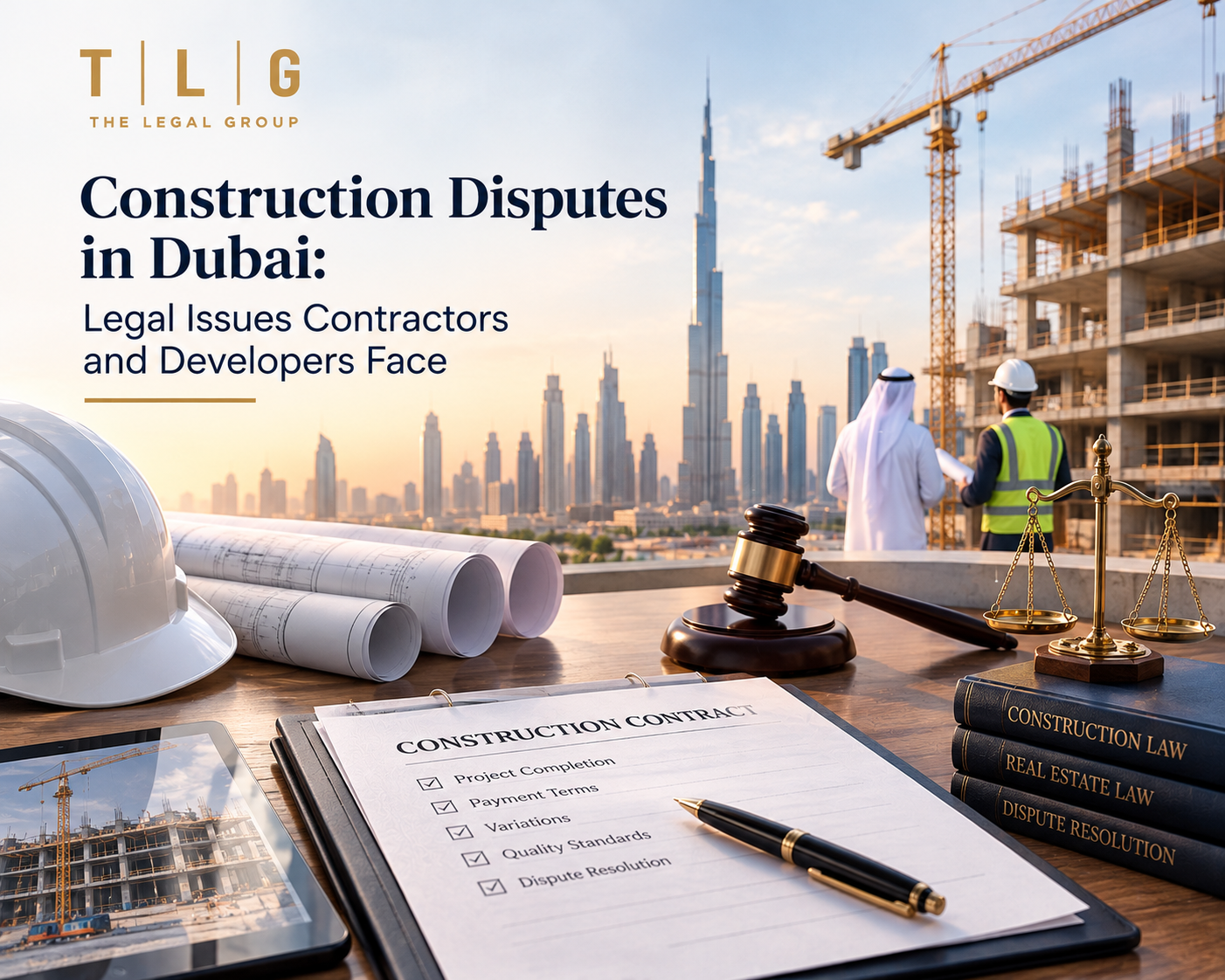
Construction Disputes in Dubai: Legal Issues Contractors and Developers Face
Construction projects in Dubai involve developers, contractors, subcontractors, engineering consultants, suppliers and property owners. Each party has specific responsibilities relating to project completion, quality standards, payment obligations and contractual performance. When these responsibilities are not fulfilled as agreed, construction disputes in Dubai can arise and affect project timelines, budgets and business relationships.
Understanding the legal issues that commonly affect construction projects can help businesses identify risks, manage contractual obligations and consider appropriate dispute-resolution options. With clear agreements, proper documentation and timely legal guidance, parties can better protect their commercial interests.
What Are Construction Disputes in Dubai?
Construction disputes in Dubai are disagreements arising from construction contracts, project execution, payment obligations, design responsibilities or the quality of completed work.
These disputes may involve developers, main contractors, subcontractors, consultants, suppliers or property owners. Some disagreements can be resolved through negotiation, while others may require mediation, arbitration or court proceedings, depending on the contract and applicable law.
Common examples include delayed project completion, unpaid invoices, disagreements over additional work, defective construction and disputes concerning contract termination.
Common Legal Issues Contractors and Developers Face
Project Delays and Late Completion
Project delays are a frequent source of construction contract disputes in Dubai. Delays may arise from design changes, late approvals, material shortages, payment issues or circumstances beyond a party’s control.
Disagreements can develop when the parties differ over responsibility for the delay, extensions of time or contractual consequences.
Construction contracts should clearly establish completion requirements, notice procedures, extension-of-time provisions and the process for assessing delay-related claims.
Payment Disputes and Outstanding Invoices
Payment disagreements can affect cash flow and disrupt construction activities. Contractors may claim that invoices remain unpaid, while developers may dispute the amount claimed or the quality and completion of the relevant work.
Construction payment disputes in Dubai may involve progress payments, retention amounts, final accounts, variation claims or disputed deductions.
Parties should maintain accurate invoices, payment certificates, contractual records and correspondence to support their respective positions.
Variations and Additional Work
Construction projects may require changes to the original design, specifications, quantities or scope of work.
Disputes can arise when additional work is carried out without clear written approval, or when the parties disagree about the cost and time implications of a variation.
A well-drafted construction agreement should explain how variations are requested, approved, valued and documented.
Defective Work and Quality Disputes
Disagreements may arise when construction work allegedly fails to meet agreed specifications, approved designs or applicable technical requirements.
Construction defect disputes in Dubai may involve structural concerns, finishing defects, unsuitable materials, incomplete work or disagreements about responsibility for rectification.
Relevant evidence may include inspection reports, photographs, technical assessments, completion certificates and contractual specifications.
Subcontractor and Supplier Disputes
Main contractors often depend on subcontractors and suppliers to complete different parts of a project. Disputes may arise over delayed deliveries, incomplete work, product quality, unpaid amounts or conflicting contractual responsibilities.
Clear subcontracting arrangements can help define work requirements, payment terms, delivery obligations and responsibility for delays or defects.
Breach of Construction Contracts
A breach of contract may occur when a party fails to perform an obligation required under the agreement without a valid legal justification.
Examples may include failing to complete agreed work, not making contractual payments, supplying non-compliant materials or failing to follow agreed procedures for variations and approvals.
The legal consequences depend on the contract, the circumstances and the applicable law. Depending on the facts, the parties may consider remedies such as payment claims, damages, negotiated settlement or other legally available relief.
Businesses facing a potential breach should review the agreement and preserve relevant evidence before deciding how to proceed.
The Importance of Construction Contracts
A clear construction contract in Dubai can help prevent misunderstandings by defining the rights and obligations of the parties from the beginning of a project.
Important provisions may address:
- Scope of work and technical specifications
- Project milestones and completion requirements
- Payment schedules and certification procedures
- Variations and additional work
- Extensions of time and delay-related claims
- Defect correction and maintenance obligations
- Insurance and allocation of contractual risks
- Suspension and termination
- Governing law and dispute-resolution procedures
Contract terms should reflect the nature of the project and the parties’ commercial arrangements. Standard contract wording should not be adopted without checking whether it suits the particular transaction.
How Can Construction Disputes Be Resolved?
The appropriate approach depends on the contract, the parties involved and the nature of the disagreement.
Negotiation
Negotiation allows the parties to discuss the issue directly and explore a practical solution. It may help preserve commercial relationships and avoid unnecessary escalation.
Mediation
Mediation involves a neutral third party who assists the parties in seeking a mutually acceptable settlement. It may be useful for disputes involving payment, delays, variations or contractual responsibilities.
Arbitration
Where a valid arbitration agreement applies, the parties may resolve their dispute through arbitration. The process generally involves an independent tribunal considering the parties’ evidence and arguments before issuing an award.
The arbitration clause should be reviewed carefully to understand the applicable rules, forum and procedural requirements.
Court Proceedings
Some construction disputes may need to be brought before a competent court. The appropriate forum and procedure depend on factors such as the contract, jurisdiction provisions and applicable law.
Before initiating proceedings, parties should assess their contractual rights, supporting evidence and potential legal risks.
Documents That Can Help Support a Construction Claim
Proper documentation can be important when a construction disagreement develops.
Relevant records may include:
- Signed construction contracts and amendments
- Approved drawings and specifications
- Invoices and payment certificates
- Site reports and project schedules
- Written notices and correspondence
- Variation requests and approvals
- Inspection reports and photographs
- Expert assessments
- Records of delays and completed work
Maintaining organised records throughout a project can make it easier to establish what was agreed, what work was performed and how the dispute developed.
How Contractors and Developers Can Reduce Legal Risks
Businesses can take practical steps to reduce the likelihood of construction disputes.
Review contracts before signing: Confirm that responsibilities, payment conditions, project milestones and dispute-resolution provisions are clear.
Document changes in writing: Record variations, approvals, revised specifications and any agreed changes to the completion schedule.
Monitor project progress: Maintain regular records of work completed, delays, inspections and outstanding obligations.
Address payment issues early: Raise invoice disagreements promptly and follow the contract’s procedures for notices and payment claims.
Obtain legal advice when needed: Early review can help identify contractual risks and clarify the available options before a disagreement escalates.
Why Hire a Construction Dispute Lawyer in Dubai?
A construction dispute lawyer in Dubai can help contractors, developers, subcontractors and property owners understand their contractual rights and responsibilities.
Legal assistance may include reviewing construction contracts, assessing payment or delay claims, preparing formal notices, advising on alleged breaches and explaining the available dispute-resolution procedures.
A lawyer may also work with technical experts where the dispute involves construction defects, project delays, engineering issues or complex payment calculations.
The appropriate legal strategy depends on the facts, the contract and the applicable law.
How TLG Can Help With Construction Disputes
The Legal Group (TLG) provides legal support for clients dealing with construction and contractual disagreements in Dubai and the UAE.
Assistance may include reviewing construction agreements, advising on payment disputes, assessing contractual claims, supporting negotiations and explaining options for mediation, arbitration or litigation.
Businesses and property stakeholders can learn more about construction dispute legal services through TLG’s relevant legal service pages.
Conclusion
Construction disputes in Dubai can arise from project delays, payment disagreements, variations, defective work and breaches of contractual obligations. These issues can affect project delivery, financial planning and relationships between developers, contractors and other stakeholders.
Clear construction contracts, accurate documentation and timely communication can help reduce the risk of disputes. When disagreements arise, reviewing the contract and obtaining appropriate legal advice can help parties understand their rights and consider the most suitable way forward.
Disclaimer: This article is for general informational purposes only and does not constitute legal advice. The outcome of a construction dispute depends on the contract, the facts and the applicable UAE legislation. Specific legal advice should be obtained for individual circumstances.